Massage Gift Certificates: Let Relatives Know It’s What You Really Want!

This time of year, we’re all trying to find the perfect gift for everyone else.  And of course, our loved ones are trying to do the same for one another, and for us as well.  It’s truly a great tradition to give graciously to one another, however, finding a gift that fits is the challenge.

Massage Therapy

Massage Gift Certificates are a thoughtful gift

So many times, I’ve written about how Massage Gift Certificates are a great way to show others that you care.  But just this morning, I realized that rather than only trying to spread the gift of healing to others, it would also be a great idea to let others know you love massages, and would appreciate that sort of a gift.  Hint.  Hint. Lol

If your family or friends like making Christmas, Hanukkah, Diwali, or Kwanza lists, seriously consider adding Massage Gift Certificates as a starred-item.  Too often, we get gifts for others that may be universally appealing, and that they really like, but would have been the perfect gift for you as well.

Or, we get gifts that would be most appropriate for ourselves.  Receiving such a  gift, you  wonder why you’ve received a Winnie-The-Pooh jogging pants set, Winnie The Pooh laptop case, and Winnie The Pooh Pen.  Of course!  The gift-giver just loves Winnie The pooh.   It all makes sense now.

But did you also err in this way?  Was your gift-giving lacking the consideration of what someone else might prefer, enjoy, make use of, or just wish to have?  That same Pooh-Bear lover received a pair of Avia sneakers from you.  Sneakers are a great gift.  Who doesn’t want a shiny new pair of kicks?  That’s all well and good, but oddly, this Winnie The Pooh girl only wears Prada or slippers.  Awkward.

So what’s to be done?  Ask others what they like.  Let them know  what you like.  Talk with them.  Think about what you know they enjoy and what brings them happiness.  And remember, if you want a massage for Christmas, you have to let others know.


Don’t feel disappointed that none of your Hanukkah gifts included a Massage Gift Certificate.  Was your husband supposed to be a mind reader, too?  Communication and thoughtfulness go far in helping us to give gifts that others will love.  If you do

n’t like lists, then just keep it casual, but do discuss.  W

ithout a hint or two, it may be nearly impossible for others to get you any gifts that you’ll enjoy.

Massage at home gift certificates

Give the gift of massage

And in no way does this spoil the joy of receiving a great gift!  Think of kids getting gifts from Santa.  Kids make lists, go tell Santa Caus at the Mall what they want, and hope and pray they’ve been good enough to deserve all those toys.  Knowing ahead of time that what gifts they want  makes it no less amazing when they  receive those gifts.

We exist as spiritual beings in a material world.  Anything that helps bring brightness to one another is amazing.  Gift-giving, when done with kindness and thoughtfulness, is a great way of letting someone know that you appreciate them.  Remember that the process can be facilitated by asking questions, thinking of what you know about your loved one, co-worker, or friend, and being a little bit creative.

You may find, after a little bit of talking, that neither of you want any more leather belts or coffee mugs, and both of you would rather have the Seinfeld box set of Season 1.  Now that’s specific.  If you really don’t know what the other person wants, Therapeutic Massage is a great general sort of gift that is appropriate for nearly everyone.  Gifts that bring healing, peace, calmness, and don’t require much work on the part of the recipient, are definitely always a hit.  But still, ask if you can.

(C) Copyright 2014 H Miller

Posted in At-Home Massage Articles, Massage and Health | Tagged , , , , | Leave a comment

Friday Absenteeism In the Workplace: Office Chair Massage As A Cost-Effective and Trouble- Free Remedy

The cycle of the week is daunting.  But as a Manager or company owner, your concern is productivity, and keeping your workers going is of paramount importance.

In the United States, and likely in many other places, the workweek drains and drags on, causing many companies to experience a higher-than-average level of absenteeism on Fridays.  Some companies have attempted to address this by making Friday a “work-lite” day where playing with your I-phone is the norm; others have decided to make Fridays “casual” days, loosening the restrictions on what it’s appropriate to wear, sometimes being so lax  as to include pajamas and workout attire!

Sometimes a company will have an extremely strict policy of no absenteeism on Mondays without a doctor’s note.  In other companies, the culture is that taking off on a Monday is just something one doesn’t do.

Of course, if a worker is so unwell that frequent trips to the bathroom are in order to deal with nausea, Management will always let the person leave.  At many companies, this is actually a fair representation of how it works.  No one breaks the taboo and nearly everyone returns to work on Monday.
Massage in the office
Thank about it: A week of 9-5, commuting, late meetings, plus a social life, and often a family to spend time with, followed by a Friday night staying up late, getting up early the next day for more fun, saying up late again on Saturday night, and either sleeping in on Sunday or getting up early for religious services, and then spending the rest of the day cleaning, or doing at-home tasks.

By Monday, everyone is wiped out because they didn’t replenish themselves on the weekend!  Everyone at the office is always so envious of the guy who takes off for Puerto Rico on Friday and manages to walk in on Monday morning with a tan, and a smile letting us know he knows no stress.

So we then have Tuesday as another big day for workers to play hooky.  They grind through Monday with substantial amounts of coffee, and then call out sick the next day. Or use vacation time.

Really, the issue here is helping your workers to plan better.  Having a full, vibrant life means planning time for both activities and rest.  Nowadays, we all walk around in a perpetual state of sleep deprivation.  That can’t be at all a good thing.

The idea was to make Fridays a day that everyone will appreciate.  Same for Tuesdays.  Luncheons, company sports, and even outings to restaurants definitely help bring staff members to the office, even on the dreaded Friday or Tuesday.

Chair Massage is also amazingly effective.  Some people will  still take the day off and forego the trip to Houlihan’s or Carrabba’s  with the full work gang, because they’d much rather go out to a quaint little family-owned place with their significant other that afternoon, who offered to pay anyway.  In contrast,  Office Chair Massage is something that nearly everyone looks forward to, and no one wants to miss!

And because this is the case, and because it’s your job to keep productivity high and absenteeism low, you may use this to your company’s advantage, and to your employees’ advantage as well.  Some companies begin by having chair massage on Tuesdays or Fridays, announcing the event with much fanfare, and then after the staff has developed a great appreciation for chair massage, randomize the chair massage each week.  This isn’t any sort of dirty trick; they’re supposed to be coming into work to start with!

In any event, it works.  The perception of the workplace as a place of stress diminishes, and in its place your staff will begin to see the office as a place where they can relax, feel creative, think without overload, and feel their best.  And that’s even in the midst of ridiculous amounts of work and activity!

Crazy Deadlines And Office Massage Work Well Together

Crazy Deadlines And Office Massage Work Well Together

Research the topic and learn more by clicking hereCorporate Chair Massage has been proven to help improve  a number of measurable work-related metrics, including absenteeism, morale levels, productivity, and can even help with tension and stress-related high blood pressure.  This is all really about changing the face of the workplace.
Our austere American predecessors brought us all this, and we should be grateful, but note that when they posed for group photos at their jobs, there is never even a single man or woman smiling.  Let’s not carry forward their work ethic that work must be  un-fun and tedious, but rather bring the idea of work into the twenty-first century; make your office a place where people can be productive, where creativity and careful analysis work better because your staff is calm and focused, as opposed to driven and stressed.

(C) Copyright 2014 H Miller, Mountainside On Site Massage  Therapy

Posted in Corporate Chair Massage, On Site Chair Massage, Therapeutic Massage and Society | Tagged , , , , , | Leave a comment

Girls Spa Parties and Bullying: Changing Negative Patterns Among Kids’ Interactions

Most of us have some connection to the topic of bullying.  Some of us were bullied, others have had family members or friends who suffered the same sad fate.  I certainly was not a bully (actually, I was bullied in one primary school grade by a much older child), but I’m sure some of our readers are reformed bullies, or at least we can hope.

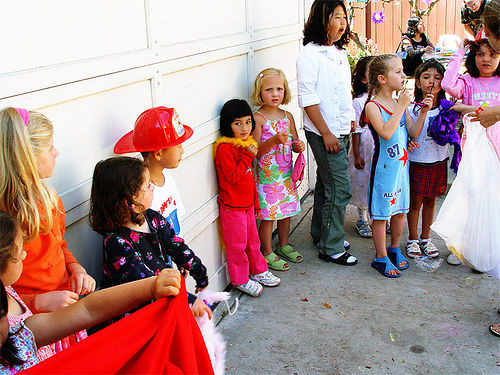
At a Kids Spa Party, kids should have fun. But sometimes  bullying occurs, and then the fun quickly ends.  Children are freer to interact at a birthday party than in school; girls cannot raise their hands to say that another girl is bothering her.  Of course, with parents, and Spa Party Therapists ever present, someone usually ends up taking a proactive approach to helping the situation.

Regardless  whether in school or at home, bullying still happens.  Even with our best efforts, sadly, this cruel social phenomenon continues.  Why are some girls driven to bully?  What makes other girls perennial targets of any passing bully?  How can these patterns of ‘meanness’ and passivity, respectively, be altered?  These are all important questions that must be addressed if we are to arrive at any viable solutions.

Parents differ in approach,  but when their own kids or guests begin bullying at Kids Spa Parties, almost every parent we’ve met has said or done SOMEthing.  Some parents can be harsh.  Others can be more reflective, trying to get the kids to think about their bullying behavior.

We have intervened as well a number of times.  I think helping the bullying girl to see that her target is a person with feelings, by treating the girl being bullied with respect, while treating the bully with equal respect, has aided all parties involved.

But no matter what the approach or personal style, it’s important that adults DO SOMETHING, rather than permit bullying behavior to continue, unchecked.

Bullying is a grave danger; children can, and have, committed suicide because they were incessantly bullied.  A quick search of Google will bring tears to your eyes.  We’ve witnessed firsthand how some girls can bully others, and have seen and felt how much it hurts.

Bullying hurts

Bullying hurts, no matter where it's happening.

In  the supportive and accepting environment that we foster, where everyone gets a turn, everyone gets a cool nail design, everyone gets to participate, and every participant is treated with respect, the dynamic of the kids’ interactions changes…at least for a short while.

Every child walks away from our Spa Parties feeling better about themselves than when they arrived.  This is not accomplished by any complex means.  Every guest participates, and in the process, is  treated as an equal to everyone else present.

This is probably why so many bullied girls like the structured environment of class time at school, because everyone gets a turn, and bullies cannot dominate and say hurtful things in the classroom, where discussion is moderated by the teacher,  like they can when kids are unsupervised and can speak freely to one another.

We treat every kid with kindness and personal respect; seeing this, they emulate the behavior.  Children are continuously learning; providing a good example to follow seems essential.  There are many amazing parents out there whom we’ve learned from, watching how they handle the situation of bullying in many different ways.

When the target of a bully gets a great nail design (I painted it; not to be self aggrandizing,  but I’ve done some pretty nice nail art!) and a  bully begins chiding another girl, saying  that her  mani came out terrible, kids and Moms nearly ALWAYS counter this, and with great gusto.

I also counter these barbs, but I choose to do so gently.  Honestly, not every mani has come out perfectly, some being quite far from any benchmark of greatness!  But when my artwork is good, it’s good.  If a young critic has a valid point, I’m always willing to listen and learn.   Kids can be really honest, but a bully might make such a claim when it is clearly not true.

Some truly Fab Tween Nail Art has been called lousy by bullying girls!  While everyone has their own opinion, it was clear that this was about the girl and not the artwork, when the topic quickly changed to how gross the bully thought the bullied girl’s clothes looked.

The curious reaction is that of the bully.  Usually, the girl doing all of the bullying will seem deflated, even hurt that any attention from the other kids is going to the target.  It isn’t being told to stop bullying, usually; it’s seeing her victim receive positive attention from others.

Why would this be?  It seems a curious phenomenon.  I do not know; if you thought an answer was forthcoming in these paragraphs, I must admit, it is not.

My best guess is that many forms of bullying have some component that is about the bully wishing to have her peers view the target as she does: through a distorted lens that the bully created, maybe out of jealousy,   maybe something entirely unrelated.

Maybe her Mom or Aunt or neighbor made a comment (that was overheard) about girls with a texture and color of hair that is different than their own; xenophobia does exist.  But racism is not at the heart of all (or probably, most)  bullying; we know this because bullying happens even within families.

It seems more important that the issue be dealt with, rather than attempting to force a blanket definition for a phenomenon that is so pervasive that it must necessarily spring from various causes.

No matter what the cause, this is one behavior that is definitely NOT cool, and the sooner bullies begin realizing this, the safer our kids will all be.   But we can’t wait for bullies to come around and figure it out on their own.  Nor can we hope that they’ll begin listening, and leave their victims alone.  They may get it; they may not.  What really needs to be done is to help the victims to stop being victimized.

We encourage parents to consider that their bullied children should be taught about how NOT to be a victim.  The ‘victim mentality’ is what must change.  Adult intervention is key.

Whether from parents, a teacher, the school lunch aide, or any other person working with children in a position to positively affect change, feedback and education will alter the course of these patterns.  Even classmates or kids on the block are in a position to help, that is, if they themselves have been properly educated regarding the topic of bullying.

Girls need to learn how NOT to become victims of bullying.  Bullies must come to understand that bullying is a detestable behavior that we will not accept.  Assertiveness is important, and feeling self-worth  as well, in preparing our kids to keep bullies at bay.  Bullies gain satisfaction hurting those who are easily hurt.

By helping girls to learn how to become more assertive, as well as understanding their own unique, individual worth, bullies will have a scarcer  choice of targets to assail with their inconsiderate (and possibly even deadly) behavior.

We have to be realistic: What does a bully aim to do?  Consciously or otherwise, bullying behavior seeks to cut off a child from her peers, make her feel a lousy sense of self, and seeks to make the victim feel totally dominated by another person.

I know there are many who feel that ‘kids should fend for themselves’, but when we honestly appraise what the end results would be, if bullies were allowed to do their damage without restraint, we see that bullies aim to destroy their targets, and sometimes they succeed.  As caring, compassionate adults, whether parents or not, we just cannot allow that to happen.

In a future article we plan to publish in the near future, we shall discuss specific strategies parents or teachers  may employ, as suggested by well-known experts in developmental psychology, as well as other reliable sources.

Two books that we shall review are Bully: It’s Time to Take a Stand, An Action Plan for Teachers, Parents, and Communities to Combat the Bullying Crisis, edited by Lee Hirsch, Cynthia Lowen, and Dina Santorelli, as well as Little Girls Can Be Mean: Four Steps to Bully-Proof Girls in The Early Grades, by Michelle Anthony, PH.D., and Reyna Lindert, PH.D.

© Copyright 2014 H Miller, NJMassage.Info

Posted in Child Health, Kids Spa Parties, Personal Growth, Stopping Kids Bullying, Therapeutic Massage and Society | Tagged , , , , , , , , , , , | Leave a comment

Couples Massage as a Unique Bonding Experience: Relaxing and Healing Together Breaks Boring Routines

Couples have held hands throughout the entire session.  That is really cute.  Do couples tend to do so more in wintertime?  I’m not really sure, but I think it may be so!  So many of our clients have told us that they are accustomed to mostly habitual living within the confines of their space, and that Couples Massage At Home helps break that boring cycle of mindless repetition.

couples winter wonderland Accidental Tourist Flickr

winter couples massage after a walk in the snow

Having a patterned, well-defined life is one thing; falling into a daily routine that is rote and unexciting is another.  Surely, using your private space for meditation, prayer, yoga, or chi kung, can help transform that space, even when you’re engaging in other  activities.  Massage Therapy is a great way to reacquaint yourself and your loved one with one another, yourselves, and your living space.

After a session of Couples Massage Therapy, you may wish to preserve that ‘vibe’ of healing and calmness.  For many of our clients, home is already a special place; many have spent a great deal of attention on creating a living space that precisely suits their aesthetic tastes.  But what goes on within the walls of that home can determine how its occupants feel about living there.

Some may argue that an uneventful life is a good life, but if every day blends into every other, that may not be so good, either.  Boring routines aren’t deliberate.  They develop over time.  Hatha yoga, Couples Massage, or even side-by-side meditation are great ways to reintroduce yourselves to your lives, and the space your lives take place within.  Living a more deliberate life is the goal, where you appreciate yourself, your loved one, what you share, as well as your surroundings.

Every day is different; every moment is unique.  Keeping this in mind, how do we ever get bored?  It’s all about developing mindless routine, as oppose to carefully planned patterns.  Living by habit is an unconscious way of plodding through life.  As the stresses of life rachet up the level of internal tension, many people retreat to the comfort and sameness of a life of mindless habit.  But routine is not inspiring; it does not encourage living each moment to its fullest special capacity.

Engaging in uplifting activities together within your shared space is a game changer.  Couples Massage, chi kung, meditation, and yoga are but a few.  There are many choices, though the inclusion of At Home Couples Massage is always a great choice, and not just because we are Massage Therapists providing such a service! Couples Massage requires no learning, as does meditation or yoga, and is a great place for you and your loved one to get started on your journey to finding the extraordinary in the otherwise routine.

(C) Copyright 2014 H Miller, NJMassage.Info, Mountainside On Site Massage Therapy

Posted in At-Home Massage Articles, Personal Growth, Therapeutic Massage and Society | Tagged , , , , , , , | Leave a comment

Post-natal Massage: Helping to Restore Your Flatter Tummy

Most women who have had their first child are very disappointed at the (lack of)  speed with which their stomach returns to ‘normal’.  In a normal situation, the stomach starts to flatten  after a couple of weeks, and becomes practically normal in a few months or more.  Without certain interventions, however, most women’s tummies will never return completely to  their pre-pregnancy appearance.

pregnant belly by Photos by Lina flickr 2

Help for restoring your tummy with post natal massage

The interventions that I am mentioning specifically relate to reconditioning of the rectus abdominis muscle so that it rejoins.  Most people  are not aware that the main muscle in the center of the stomach, the rectus abdominis, actually splits in half during pregnancy, right down the middle.

If the rectus abdominis did not split in half, it would become stretched and distended, thus rendering it non-functional after the baby was born.  Instead, our intelligent bodies preserve the form of the rectus abdominis by splitting down the middle, and retaining half on either lateral side of the distending belly.

When this process  is not understood, however, there can be later problems .  For example, if a woman begins to do stomach crunches soon after the pregnancy has ended, and before the muscle has fused back together on its own, then the rectus abdominis may remain perpetually disconnected.

This means that the stomach will never achieve the look, or have the same strength,  that it had before pregnancy, since the muscle responsible for the center of the stomach’s shape will remain unjoined at its center line.  A  gap running up the middle of a woman’s  belly would be the result, which would potentially remain until the woman becomes pregnant again, has a second baby, and lets her body heal properly.  At that time, there would be another opportunity for that same muscle to either rejoin or remain with a gap once again.

In addition to the rectus abdominis muscle being split, there are several other issues to be noted when considering the desire for your flat stomach to return.  First, the uterus was greatly enlarged, and after pregnancy it’s moved out of place.  Especially with the rigors of labor, it is highly unlikely that it is in its ideal  place within your pelvic cavity.

If its proper place is not restored, then we find yet another reason why the original tummy that the woman had before pregnancy cannot be regained.  Immediately after the birth of the baby, in order to expel the placenta, a physician will apply hard and uncomfortable pressure to a woman’s stomach.  This is to prevent hemorrhage which can occur if the placenta is not expelled.  However, this is where most physicians will end their care with regard to the stomach.  Their main concern is not whether the woman’s figure is restored, but simply to prevent her from bleeding internally, which can sometimes be fatal.

This is where post-natal massage therapy can help.  In the first post-natal massage session, (which must be performed within two weeks of the birth of the baby in order to have this effect) the massage therapist will perform a special technique to restore the fundus, (or top of the uterus) to its rightful place.

After birth, it is sitting low in the pelvis, in the wrong place, and is often not in its normal shape.  Through techniques of massage, the fundus can be restored to its natural pre-pregnancy position, thus not impeding the stomach from returning to its normal shape.

There are also several techniques that the Cerntified Prenatal massage therapist will emoploy to assist the rectus abdominis muscle with returning to its normal place and shape.  Techniques such as friction and Swedish Massage will be employed to help reduce the stretch marks that almost certainly occur after pregnancy without intervention, and which often become permanent.

There are, in fact,  many pre- and post-birth and continuing treatments which women can use to prevent stretch marks from forming on their belly.  Some are more effective than others, but one has merely to visit the pregnancy section of any health food store, Whole Foods Market, or online stores featuring natural products to find them.

Some are called pregnancy belly balm, pregnancy salve, or stretch mark reducer, and all have similar effects.  They maintain healthy tissue in the area of the stomach, and can help to create a great reduction in the appearance and severity of stretch marks.  In addition, having a number of pre-natal massages can also help to recondition the skin of the stomach so that stretch marks are less likely or less severe.

As stated, some are more effective than others, and a discussion of these products is beyond the scope of this article.  However, if stretch marks do occur, massage therapy can help to reduce their appearance and recondition the skin to appear and feel  much healthier than it was just after the pregnancy.

All in all, it is to the benefit of any post-partum woman to explore the options related to post-natal massage.  Most of the benefits discussed above, with the exception of re-positioning the fundus, require more than one treatment to truly see effects.  Sometimes the massage therapy treatments need to be continued for a month or more at regular intervals to see strong benefits, but if restoring your tummy to its pre-pregnancy look and feel is important to you, you may find that it is worthwhile to spend the time to have an experienced Certified post-natal massage therapist assist you with this.

And while this article reports only on the tummy-restoring-benefit aspect of post-natal massage therapy, there are a myriad of other beneficial effects  that this type of massage has on the new mother as well.  Prior blogs, located here, as well as our post-natal massage therapy page, located here, are excellent resources for information on some of the other benefits of post-natal massage therapy.

©Copyright 2014 H Miller, NJMassage.info

Posted in At-Home Massage Articles, Massage and Health, Post-Natal Massage, Pre-Natal Massage, Therapeutic Massage and Society | Tagged , , , , , | Leave a comment

Massage Therapist as First-Line Health Advocate: Trained in Observing Signs of Pathology, Therapists Notice And Report Health Issues Before Anyone

Massage Therapists, whether employed in a spa setting, or working with a mobile company like ours, are an invaluable part of your health care team.  Chances are, if you are a regular massage therapy client, you see the massage therapist more than your doctor.  And of course, that’s a good thing, indicative of even better things!  As a result, your Massage Therapist may be the first health care professional to observe and report to you that something might be of issue.

Of course, a Massage Therapist is not a doctor, and isn’t qualified to make diagnoses.  If your therapist is doing this, it might be a good idea to start looking now for someone new, and quickly.  Massage Therapist training includes a lengthy module on Pathology. This includes identifying all sorts of skin issues, from tinea to melanoma.  And that’s important, because a massage therapist, working on a client’s  back every two weeks, can easily be the only one in that person’s  life in a position to notice changes in a mole on a client’s back.

Unless you are a doctor, nurse, or any other highly specialized health care professional, chances are, your massage therapist has more training in identifying skin and body issues by observation than you do.  While diagnosing is definitely not something any Massage Therapist should be doing,  bringing a client’s attention to an issue that a therapist may consider worthy of more attention, or outright suggesting that the client see a doctor certainly is.

Massage Therapists are not trying to overstep their bounds or delve into the field of medicine when they make such suggestions regarding their visual, or tactile, observations.  In fact, during schooling, Massage Therapists are instructed to be vocal about anything that they feel, based on their observation and training, may be a cause for concern.  If you feel that this is inappropriate, that is your right, however, consider that the Massage Therapist was only doing what she was taught in school.

Reporting potential health issues to the client is something therapists should be doing, no matter where the massage session is conducted, whether it’s at home massage or corporate chair massage, whether it’s a fifteen minute session or ninety.  Of course, a Massage Therapist should be discreet about talking with a client, if there are others present.  Not only is this good manners, but it is the law.  As such information pertains to a person’s health, it is protected, and private.

In summary, it is fair to say that this is an aspect of Massage Therapy service that most people don’t consider at all, even though it is a valuable extra.  Having the training to recognize anything from boils to blastomas is certainly worth something to someone.  Probably, in the course of most Massage Therapists’ careers, each has reported to a client at least once.  This should be viewed as being dedicated to protocol, and not any attempt to overstep boundaries.

(C) Copyright 2014 H Miller, Mountainside On Site Massage Therapy

Posted in At-Home Massage Articles, Massage and Health, Therapeutic Massage and Society | Tagged , , , , , , | Leave a comment

Massage For Children: Even Kids Get Stressed

Children’s massage is not at all a new development, though it is not nearly as popular in the US as it is worldwide.  In many traditional cultures, massage for children is commonplace and nearly ubiquitous, such as is the case in India.  The most common reaction to the idea that Pediatric Massage helps children ease stress is the response that kids live stress-free lives.  Nothing is further from the truth, and those of us with good memory recall can remember just how stressful childhood was.

Even in

Pediatric massage at home for kids

Pediatric Massage Helps Kids Deal With Stress

a well-adjusted child, living in a caring family, there is opportunity for stress.  As “grown-ups”, we tend to patronize children, insisting that playing with Barbies can’t be quite so  stressful, and “real” stress begins with having a job and family – real responsibilities!  However, such an idea is actually insulting to kids’ real experiences, as it is a well known fact among those studying child development that kids get stressed, too.

Maybe it is the distance of time, but most of us had experiences as a child that were fraught with stress.  Stress is unavoidable.  Let us consider just a few stressors that kids deal with daily.  There’s school.  That includes deadlines for projects, studying for tests, the pressure of maintaining grades.  There are also the social stresses involved with even normal friendships, but then there’s also the more extreme stressors, such as being targeted by a bully at school.

Kids’ social lives are complex and often present ample opportunity for stressful experiences.  Kids can form cliques in the classroom, and teasing and bullying are not at all uncommon, even among girls (such as described in this book from Amazon). As children reach adolescence, they also have the added stress of dating and dealing with the added freedoms that go with that period of life.

Peer pressure also creeps in around this time, as more freedom, (and freedom from adult supervision) of course,  means more kids doing what adults tell them not to do.  This can be incredibly stressful for kids, as they are alone for the first time without their parents’ protection, and must make sound choices on their own for the first time in their lives.

Home life can also be a significant source of stress for kids.  Even under ideal conditions, there are all sorts of situations that can be stressful, from competing for the bathroom in the morning, to dealing with a diet that the child does not like.  Some families are not so stable, and kids are exposed to all sorts of stressful scenes, sometimes culminating in parental separation or even divorce.

Then there’s sports.  And the arts.  It’s great when kids are involved in these extra-curricular activities, because they present the opportunity for a different sort of learning, however, such activities  also present opportunities for stress all their own.  Kids may have performance anxiety, whether it concerns batting at softball, or playing Beethoven in a piano recital.

It’s all very easy to laugh at our kids when they come to us complaining of feeling stressed.  Adults may even say how cute this is, and get a good laugh out of it all.  But the life of a child is often stressful, as life itself is inherently stressful.  Massage For Children is definitely appreciated by pediatric clients; their feedback suggests that kids  experienced a much higher level of stress before the session than after.  Most of these unprompted comments demonstrate that children really are as stressed as psychologists tell us, and further, that Massage for Children is actually a great solution for dealing with such stress.

Beginning with infants, Pediatric Massage has been found to be helpful to kids in numerous studies. (Check out our studies page by clicking here) As kids get older, Massage Therapy helps different sorts of issues that generally occur at each stage of development.  Parents should consider learning basic infant massage; there are a plethora of books and videos available, and local classes are easy to find in most cities and even suburban areas.

Massage for Children on site is another choice.  Massage Therapists travel to your location and provide therapeutic massage for your child, right in your own home.  This is quite helpful in that kids may find the new surroundings of the day spa intimidating and stressful, in and of itself.  Having a massage session in the familiar surroundings of home, definitely helps pediatric clients to feel more at ease.

Whatever you do, don’t laugh at your kids when they complain about feeling stressed.  You may be doing so innocently, not realizing that your child is serious, and may be feeling a high level of anxiety or tension, and you may be inadvertently keeping him from trying to tell you again in the future.

Some adults seems to think that when kids complain of feeling stressed, they’re just mimicking adults.  Studies, anecdotal reports of others, as well as  our own experience working with children, suggest otherwise.  Childhood and adolescent stress is real.  The claim that kids are stress-free may be the prevailing sentiment  in society, but we should all know better by now.

(C) Copyright 2013 H Miller, NJMassage.Info, All Rights Reserved.

Posted in At-Home Massage Articles, Massage For Children, Therapeutic Massage and Society | Tagged , , , , , | Leave a comment

Massage For Children: Fostering Assertiveness Through Client Empowerment

Being assertive means being fully capable of  expressing one’s feelings, thoughts,  and needs directly, openly and honestly, asserting one’s rights, in a manner which is yet respectful of others. (Lloyd, 1998)  As a Massage Therapist who works with children, I have found that Therapeutic Massage has an added benefit to kids that, thus far, seems to be unmentioned in any literature, or anywhere else on the web.  My observations suggest that therapeutic massage may help kids learn to be more assertive.

“How is this so?”, one is likely to ask.  It’s not as though having sore muscles soothed, in and of itself, has any obvious connection to increased assertiveness.  Rather, it’s about the manner in which  we orient our clients of all ages, the young, the middle aged, and the elderly,  to their massage sessions, and to the therapist.

Massage for children and massage for young adults, middle aged people, retired people, and even the elderly differ significantly in some major respects from one another.  Even so, I make sure that each and every client  receives the same message verbally at the beginning of the session.  I make certain to explain that the massage therapy session should not be intolerably painful.

I explain to all of my clients, kids included, that during the session they  may feel how sore some of their muscles are.  That’s normal.  Everyone carries around a lot of stress, and kids are no different. Some muscles are tight from stress, or overworked from competitive sports training, or a plethora of other reasons. But if a muscle is sore, I explain, it shouldn’t be extremely uncomfortable or intolerably painful while I’m working on that area.  If it does, that means I need to use less pressure there.

I further explain that if they feel  I’m using too much pressure, then  it’s important to immediately speak out and say so.  Reducing muscle tensions has proven benefits of reducing stress, while using more pressure than a client is comfortable with is not conducive to relaxation of any sort!   It’s just painful at that point, and can have the exact opposite effect on a clients blood pressure from a massage therapist using an appropriate amount of pressure.

With kids, this establishes the habit of being assertive, able to voice their objections to others, letting others know how they feel.  This establishes an important behavioral pattern  of realizing that they are in control of  their lives.   And, the benefits of assertiveness do not end there.  This is a key quality that we should try to help children develop, because it can help every area of their present and future.

During the first few minutes of  a session with any new  client, I make sure to ask a few times if  the pressure is comfortable. (Not so much that it’s bothersome, however!)  And this practice of verbally stating to the client that they are the one directing the session  is important for  all age groups, not just kids.  Once I let the client know that it is acceptable to let the therapist know that the pressure is too much, clients are far more likely to say so if they are not finding what I’m doing to be helpful.

I’ve found that elderly people are least likely to speak out and provide feedback without prompting.  I would have though it would have been the exact opposite situation.  Maybe it’s a vestige of their generational passive orientation toward health care providers?  I can’t be sure, but I know that it helps to ask if the pressure is OK, rather than assuming that because a client is quiet, they are comfortable.

And of course, there are times that we underestimate the amount of pressure a client can comfortably tolerate.  We all have a different pain threshold, different neurology, as well as other physiological and physical structural differences that make it almost impossible to know 100% of the time how much pressure to use with a client.  Asking is key.

Once these parameters have been established verbally, and kids know that during their massage session that they are the person in control, most children speak up without a problem.  This changes the experience from a purely passive one, to an active, engaging healing activity that the child has a lead role in.

Sometimes with younger clients, it’s good to engage in talk during the session, or at least during the beginning segment of time.  Some modalities of Children’s Massage employ storytelling and simple games, especially for the very young.

Others Children’s Massage modalities do not, including a few very popular traditional Therapeutic Massage for Children modalities that originated  in various cultures worldwide.  Simply  asking kids to talk about the activities they engage in  and where it hurts is also sufficient, and provides a better understanding to the therapist of the client as an individual with unique issues.  Of course, such a mini- interview is another key that a competent massage therapist should employ for clients of all ages.  This will be addressed in a later article.

While a good Massage Therapist has developed their sense of touch through practice, and should know, based on experience and intuition,  how much pressure to use for each client, based on muscle tone, the depth of pressure sought by the client, and other factors, it’s still most respectful to the client, both children and adults, to ask if the pressure is acceptable.

When asked if the pressure is comfortable and everything is alright, kids will reply honestly.  So of course, a Massage Therapist should always ask.  And that’s true for all age groups.  Therapists don’t have to wait for the client to voice a complaint and can be proactive and initiate the communication.

By the end of even a brief session, kids are usually gabbing away, explaining how dance class makes their legs hurt, or how a book-bag, overstuffed with a heavy hardcover textbook for every subject, is hurting their back .  Conducting a massage session where it’s clear that the client is in control fosters open  therapist-client communication.

Kids can’t be afraid of hurting their massage therapist’s feelings!  It’s important that they know a therapist is not omniscient, and it’s their role during a session to speak up immediately whenever they want the therapist to modify the technique or change the amount of pressure.  Even if it’s simply to suggest spending more time on an aching back, sore from team sports and ballet, rather than to voice a complaint about the pressure, speaking up is important during massage sessions for kids.

Likewise, children need to develop the working habit of being able to speak up with others. This is definitely a vital life skill for any kid to possess, and can prevent untold miseries all the way from childhood well into adulthood.  Assertiveness can help a kid deal with every sort of social challenge, as well as later peer pressure that inevitably goes with adolescence and the college years.

Massage for Children has many benefits proven by dozens of studies.  Increased assertiveness  is yet another benefit, one that should be better appreciated.  Of course, this is merely my observation as a Massage Therapist, and I haven’t conducted any studies proving this to be so!  And further, it’s the manner in which we communicate with our clients that seems to be the empowering factor.

Please be aware that I am not claiming that increased assertiveness  is among the various (proven) health benefits of massage therapy  (there are indeed many;  Click Here To Link to Our Massage Studies Page); however, this is just an account of what I’ve seen, purely anecdotal.    Even so, any good massage therapist would conduct their sessions as we do, keeping the client in charge, and letting the client know that this is the case.

Becoming more assertive is a key part of growing up healthily, and every opportunity kids have to develop that skill should be exercised.   Assertiveness is linked to kids’ confidence, and helps kids to stand tall, respecting their own choices and wishes in the face of challenges and challengers.

Parents and teachers should, of course, focus on helping their children develop these skills at every opportunity, as it’s that important a facet of development.  Kids who are more assertive are empowered with  greater self-strength.  Ultimately, kids who are empowered grow up to be able to better deal  with personal  relationships, work peers, and the various  unavoidable stresses of life.

Massage for Kids can help empower children to help assert themselves when encountering others, knowing that they are in control of their choices.  This may even help keep a child from being the target of bullying at school.  Assertiveness is not aggression, but seems to be a great means of  dealing with aggressive people.

Of course, there’s far more to helping kids become more assertive than having them go for a session of massage therapy!  Parents  and teaching  should focus on empowering children to have a voice, helping  kids understand that there’s a way to respectfully express themselves in every situation, and  if they feel the need to do so, then it’s their responsibility to speak up.

(Click Here to Link to Our Kids Massage At Home Info Page)

©2013 H Miller, Mountainside On Site Massage Therapy

Posted in At-Home Massage Articles, Kids Spa Parties, Massage and Health, Massage For Children, Therapeutic Massage and Society | Tagged , , , , , , , , , | Leave a comment

Spa Parties, Money Skills, and Their Lack of Real Correlation: Considering the Matter Further

Only six months ago, a thought-provoking  article was published by Reuters authored by Chelsea Emery entitled, “Your Money – Spa parties and money-smart daughters.’ Only a few days ago, I encountered this article for the first time, and in the intervening time, I’ve been thinking quite a bit about what Chelsea had written.

It seems that the premise of the Reuters piece is that Spa Parties for Girls are a deleterious force in a young girl’s life, potentially helping to foster  an attitude inconsistent with future financial literacy, which will present its negative outcomes later in the child’s life.

While it is an indisputable fact that young women are lagging considerably behind their male counterparts regarding knowledge of financial terms and the like, as evidenced by researchers at  University of Pennsylvania,  Harvard, and Dartmouth, as cited by Ms. Emery, I strongly disagree that Kids Spa Parties are a factor.

Firstly, most young women today did not attend a Kids Spa Party as a youth.  The phenomenon really took off only less than  five  years ago, and since then, has exploded in an exponential growth so rapid that now there are literally hundreds of such companies catering to those seeking Kids Spa Parties.  It is currently ‘the’ big thing for young girls, however a decade ago this was just not so.

Therefore, any trend indicating a gender disparity regarding  financial savvy  cannot be connected to the current trend of rising popularity of Kids Spa Parties.   The conclusion we must draw is that the source of young women’s current lack of financial knowledge must lie elsewhere.  The younger Kids Spa Party set just hasn’t made it to university yet.  Perhaps they’ll fare better than the older generation now on campus, perhaps not.  But we argue that Spa Parties are likely not going to be  a factor either way.

In this article, we shall explore the  argument presented in Your Money -Spa parties and money-smart daughters, considering the ideas discussed  and responding.  While we certainly agree with the notion that such a gender gap in knowledge about finance  should be eliminated, our recommendation for doing so is through better education, proven programs that are tested and work, as oppose to the author of the Reuter’s piece who believes that change must begin with a change in parenting style.

Girls and boys need to learn about finance in elementary, middle school, high school, and again at university, each time delving deeper into the topic, with the same depth of attention and importance currently invested in studying  science and math courses at each of those levels.  Such finance courses must be made mandatory for all students, in all academic tracks, because all students need this valuable knowledge.

Blaming Kids Spa Parties or lipstick is easy; these represent more traditional values esteemed  by  women, such as attention to beauty care and  appearance, whereas in today’s society, such values are sometimes  considered a throwback to ‘ patriarchal’ ideologies, and are not always granted respect, even by women.  But plenty of women…in fact most…still care a great deal about their appearance.

In fact, I would wager  that nearly every  woman ( and man, even) on the board of every  Fortune 500 company, pays a great deal of attention to her  or his   personal appearance.  How we look is, after all, an essential detail  in every business setting, even at Reuters News Service, one would imagine.  And this is true for both men and women.

Kids Spa Parties, in our experience, are not ever a substitute for gifts by parents.  If the parents had not chosen to have  a Kids Spa Party, they would probably have had their daughter’s  birthday hosted at a bounce house, or any of dozens of other sorts of venues specializing in kid- themed birthday parties.

Whether providing a Kids Spa Party, a day trip to Sesame Place, or  a simple at-home traditional cake and Pin the Tail On the Donkey  soiree, parents seem to always get gifts for their daughters.  Chelsea Emery mentions that her daughter had attended three Spa Parties in eighteen months.

Yes; Spa Parties are quite the rage for young girls in the USA right now.  And yes, it’s a great feeling for many parents to show their kids they care, being more and doing more, providing experiences and opportunities  they themselves didn’t have growing up, even though many  parents today were provided for  quite well.

The article continues  that the author’s  daughter’s friend, who happens to be a boy, requested donations from partygoers so that he could pool the funds and purchase an expensive $400 Lego “Death Star” puzzle, instead of the more conventional  practice of every guest bringing a gift of their own choosing, either  based on a list of known items, or considering what’s known about the birthday boy or girl  from personal knowledge of their  interests..

Chelsea Emery then proceeds to ask:

Is it any wonder that Annabelle and her girlfriends want to spend their allowance on nail polish, while Aleksandar, having raised the money to buy his Lego set, has begun saving for a sports car?

Upon my first reading of this passage, I did not quite understand that the author is actually praising Aleksander for his bold business sense at the mere age of eight, rather than pointing to the obvious: that in polite society, Aleksander’s parents  would be in the position of gently explaining to Alexsander that he should be a gracious host, and with a smile, thankfully  appreciate whatever  each guest brings.  And then, of course, if Aleksander is deserving, the parents can buy the $400 Lego Death Star if they feel it’s a good gift for him.

Maybe Aleksander’s  parents could not afford the $400 themselves.  That in itself is ironic and worthy of further thought, that they would encourage their child to spend such vast sums, out of even their own reach.   Are these  sound financial habits to encourage  kids to develop?

Spending  is not saving.  Spending $400 on a Lego puzzle is no more a sound practice than buying two hundred tubes of lipstick in all shades of hot pink!  Maybe less so, as the lipstick would  be used in time, while the Death Star Lego puzzle will likely end up sitting  on a shelf  collecting  dust.  And spending on a toy is not investing.  Nor is spending on a car or luxury cruiser.  Or clothes.  Or movie tickets.

Claiming that a Spa Party is a waste, while a toy Death Star is not,  seems somewhat arbitrary.  And of course, there’s the obvious question:  If it’s good ‘money practice’ for a  boy to ask to pool his gifts  for a massively cool (and costly) Lego Death Star, maybe parents not wishing to spend (or lacking the funds)  can encourage their  daughters to likewise save up year round for a Kids Spa Birthday Party?

What, at all, is the message here?  That toys are somehow better than parties?  Both are, in the end, extravagances, and our kids are lucky to have either.  Life would be very grey and bland with parties and toys and entertainment.  What honest American adult can disagree?  But of course, there’s more to life than having fun after all.  There’s
spending.  And then there’s also saving.  And investing.  And donating.

Helping your kids to save for truly worthy causes, whatever they may be, whether items as learning aids, books & e-books, laptops, mini-printers, and  computer programs they can use to create, say e-greeting cards to sell on Etsy, is a suitable way to show kids how to have goals, how to invest in something that will bring a return.  And, kids can start earning pocket cash (and sometimes, far more) when just out of grade school.

Children are never too young to let kids learn about capitalism firsthand!  Or about kindness, and the wonderful reality that in our society we can donate our time, money, and abilities to help others.  And saving up, not just for future big purchases, but to have some funds so that she will never be without a few dollars to spend, is another important lesson to learn.

Or, kids can be encouraged to  save for fitness or sports equipment.  Investing in one’s own health is a lesson we should teach kids from their youngest years.  Or musical instruments and art supplies.  Developing creative expression is also an investment in our kids.

And finally, why focus on nail polish?  Can’t a girl learn to be savings-savvy,  purchasing nail polish on sale or in lots?  What is really implied here?  Aleksander isn’t spending his allowance on the Death Star, he’s asking for guests for cash so he can then pool the funds to buy himself a  gift!  How do we know he doesn’t spend his own weekly allowance on small items?  Certainly, Aleksander isn’t buying nail polish.  But there are many things, including
candy and baseball cards, to name but two, that young boys can spend their allowances on.

If Aleksander had been such a good saver, great with his personal finances, as is implied, why wouldn’t he have simply  saved up for the Death Star using his own allowance money?  By no means am I trying to disparage Aleksander! I’m merely making a point.  He was a kid, and kids enjoy  spend their allowances, whether on nail polish or gum.

The article then continues:

Perhaps pressured by subtle social cues to value appearance over saving, many girls still grow up without adequate money and investing skills despite their success in the classroom and a proliferation of programs designed to teach kids about money.

Appearance and savings are not mutually exclusive.  A girl can be taught the value of savings, the value of sound investments, and the value of good personal hygiene and appearance.  While it is certainly a sad state of affairs that it’s the case that girls lack necessary life skills, research should be directed to this area, aimed at finding out why
these (existing) programs fail young women.  There is no such mandatory financial literacy course at most community colleges and larger universities.  Adding this to the list of core classes would help.

Kids Spa parties serve to help girls learn that keeping their skin clean and clear  is all that all it takes to beautiful.  And that is important.  As girls enter adolescence, they need to possess such essential life skills, as well as confidence in their own uniqueness.  But of course, it is up to the parents to teach their children  to keep it all in perspective.  While personal appearance is important, it’s far more important for kids to  remember to value
intelligence, kindness, and hard work, and to remain avid life-long learners.

Make no mistake: all parents need to teach their children – boys and girls – about money. But girls encounter different social and environmental messages, and those messages can be financially crippling. It’s now common to find girls’ clothing with slogans like “I (heart) shopping,” something that never appears in the boys’ department.

While it is true that girls and boys receive different subtle reinforcements from the media, their  family members, and society at large, there’s no getting away from the fact that we all live in a mass consumer culture.  Men shop, just as women  do.  They just don’t celebrate it.   Or  ever even call it shopping!

Just check out the local mall and see for yourself.   And men seem to spend more on big ticket items than women pretty consistently.  But there is no arguing that girls are socialized differently than boys regarding spending and the activity that generates spending, that is, shopping.  Is a shirt emblazoned with the message, “I (heart) shopping,”
that damaging in any  way?

If a girl has a solid foundation, an upbringing based on expressing herself creatively, living with a balance of rational thought and intuitive feeling, and remembering that intelligence,  hard work, and honest values are paramount to success, a shirt’s message isn’t going to harm her.

Even during the  recent pre-holiday shopping season, I’ve noticed many men never say, “I’m going shopping”.  Rather, it’s more often something like, “Getting a few Hanukkah gifts today”, or maybe, “I hope I  find my brother  a great Christmas gift at the Best Buy in the  Mall later!”  Never do they mention the dreaded ‘S’ word, as shopping is, by and large, perceived by most to be something women do.

Yes; that does seem a bit  sexist, but like it or not, that’s  how many people think, men and women alike.   But maybe it is true that women enjoy the act of  browsing  more than men, for whatever reasons, and men generally go to the Mall knowing what they’ll buy, and quickly  leave afterwards?   Or just forego the whole experience and shop online?  Shopping, for many girls and women,  may really mean something more like spending a lot of time looking, rather than necessarily spending money buying.

And of course, shopping means socializing, getting to spend an afternoon with ‘the girls’.  Shopping is a social activity, and is usually one of the first activities kids do on their own, without their parents.  Being a smart shopper is key.   In a consumer-based culture, getting kids out, learning how to shop, how to save, how to read labels, and how to buy from real want or need -and not impulse -are all key.  Shopping affords girls -as well as boys- the opportunity to participate in market transactions as a buyer.  This is, indeed, preparation for later financial realities.

This cultural trend of associating shopping, and thus spending, with regard to women and girls, has nothing at all to do with Spa Parties, as Kids Spa Parties do not engender feelings of a strong need to go out and  shop.  Girls usually do not leave the party wanting to buy fifty colors of nail polish. Or  blue jeans.

Nor do kids  walk away from Spa Parties as  ultra-selfish  materialists; their worldview is usually unaffected, though they may feel a little more secure about their own self-image.   I’ve talked with many Moms weeks, even months after a Kids Spa Party, and they didn’t mention any negative change in their daughters.  I do not see Kids Spa Parties as reinforcing any subtle  social cues to spend excessively  on beauty care items or clothing or shoes, or to obsess about  one’s appearance.

Kids Spa Parties are about self acceptance, and the acceptance of one’s peers.  Everyone gets to participate, everyone forgets their usual self-conscious self  and laughs and has a lot of fun with their  friends, and that makes many young girls feel good about themselves.  It is an experience many kids  cherish.

Positive experiences like this are the key to building a strong self image, something that can help a girl combat the constant onslaught  of (actual) social cues in advertising,  compelling her to buy in order to feel adequate.  Or later, the peer pressure that comes along with being a teen, pressure that may involve cigarettes, alcohol, drugs, relationships, or to go places without permission, or sneak  out of the house.

A girl should buy a sweater or nail polish because she likes it, not because it’s trendy.  Self-security is important, and a girl needs to learn to be a leader, and not to mindlessly  follow the crowd.  Self expression is lost when a person only looks externally for how to be and what to like.

So,  if a girl wants something because she genuinely likes it, and isn’t just buying because every other girl has the same item, she should consider buying  that item.  If she can afford it, that is.  If a girl doesn’t have an understanding of what ‘afford’  even means, that’s a  real  issue.  Education at home and at school can resolve such issues.

Of course, everything  we do in life requires that we spend in some way.  No mature person can honestly claim otherwise.   Even  a nice hike with the kids in the park, something free in and of itself,  entails buying suitable attire and footwear for all beforehand, as well as spending for fuel, in order to somehow get there.  Learning to be a smart shopper is important, as we’ll always have to shop for food, clothing, fuel, and everything else we use in a day.

“(My boys) don’t get invited to spa parties,” says Mary Blanusa, a vice president at the Council for Economic Education in New York and Aleksandar’s mother. “If I had girls, I’m sure it would be different. There’s a lot of pressure on girls to have certain things and look a certain way.”

Kids Spa Parties are fun.  It’s only entertainment, after all.   There is no pressure for kids to look any particular way; in fact we find it is a great means of helping each of the girls to  feel an increased  sense of self esteem and personal worth.   Girls can choose what designs they want for their nails.  The colors and styles are fun and bright.  It’s all meant to help the kids relax and experience a situation where each of them can feel good about themselves.  And it’s a way they can express their unique individuality and style.

As far as boys attending Kids Spa Parties, we’ve had it happen many times now.  Granted, it’s usually a cousin or sibling, but there’s no reason a boy can’t attend.  Of course, most boys will only consider certain services (though a clear coat of nail polish is nothing serious), but even teen football players appreciate the facial activity.

Acne plagues teens, and so far,  any boys present at parties have had facials without anyone else teasing or thinking it odd.  And hair styling…tween boys want to look their  best, and creating a  cool hairstyle with gel  is always appreciated.  What’s so odd about this?  True; many do not have boys attend their daughters’ parties, though on our Kids Spa Party web page, we specifically explain that boys need not be ostracized and may attend if
parents wish.

This isn’t encouraging anything other than good body care habits for boys.  After all, they  need to learn to style and comb their hair, keep their nails trim, and keep their skin clean.  Boys and girls do this every day.  Kids Spa Parties are not contributing to any  trend of  excessive self-preoccupation.  In a post-industrial society like ours, learning to look presentable is becoming increasingly important for both sexes, in business, in personal
relationships, and literally everywhere. As we shift to a service economy, this is essential.

The point is, there is no inherently subversive ‘subtle spa-party messages’, as the author refers to them.  The message is that it’s fun to look our best, we all have intrinsic value as unique individuals, we all have our own sense of style and personal taste and aesthetic preferences.  Kids Spa Party guests also learn that  it’s fun to take care of our skin and nails and hair.

Kids learn to relax and have fun in the company of  friends  and siblings.  Certainly, the subtle message here is really something like, “we’re all beautiful, each in our unique way.”   Simple as that.  Kids Spa Parties are not somehow inherently contraindicated  in the raising of ‘money-smart’ young women.

The  author’s lesson of letting her daughter run a lemonade stand (a great idea, though seriously, check to find out if it’s OK where you live as  you don’t want your kid to run afoul of local code and receive  a ticket!) is  a sound means of teaching about money , as  kids must have opportunities to learn actively.  The video game ‘Lemonade Stand’ is a great example of a simulation that can teach kids about cost of materials, market conditions, and more.

It’s been around in one form or  another since about 1977.  Now, three or four generations have played the game in their youth, often back on the school computer when computers first appeared in the classroom starting in the late 1970s with TRS-80s and Commodore PETs.  Kids today can also learn about business and money by selling on eBay, Amazon, or Etsy.

The Girl Scouts, we must agree, are a worthy group to join.  And while the author cites the badges for “money manager,” “financing my future” and “budgeting”, some Spa Party companies also let Scouts earn  Girl Scout badges at Spa Parties.  There is the Official Girl Scouts Spa party Fun badge (http://www.girlscoutshop.com/THINGS-GIRLS-DO/SPA-PARTY-SEW-ON-PATCH), and other badges can be earned at a Kids Spa Party, such as  Looking Your Best, Healthy Habits, Creative Solutions,  Being My Best, Do-it-yourself, Girl Power,  and Making Hobbies.   If the Girl Scouts recognize Spa Parties as a valid means for girls to learn, that does say something.

Modeling appropriate spending is also mentioned by the author as a good way to develop money sense.  We agree wholeheartedly.  It begins with the parents’ own sound spending habits.  Boys and girls learn at home.  Parents who revolve debt, buy everything on credit, and get everything at the highest price when it first comes out are showing their kids a lot.

This sort of behavior is far more damaging than any Kids Spa Party, even one with Chocolate Fondue and Strawberries!  Kids learn how to live by seeing their parents go about their own lives.  Being a living example of the values we wish to instill in our kids is essential.

Parents say their girls feel more pressure than boys to use their money on the latest trendy clothing. That means girls need extra guidance in making appropriate purchases, says Katherine Nixon, chief investment officer for the personal financial services business of Northern Trust Corp.

Because of social pressures, as cited above, girls do need extra guidance.  Girls must be taught about their own inherent self worth and beauty.   Kids Spa Parties are one such way of helping girls understand that they are all worthy of respect.  Their gifts such as intelligence and creativity must be nurtured, and we do that by including many active activities, such as A Spa Party Card signed by all guests.

Many kids draw pictures, or write something to the birthday girl.  We also have a Lip Balm Craft, which each girl makes herself, choosing or blending flavors as she sees fit.  Our  Soap Making Craft also allows a choice of shapes, and scents.  Active learning is especially good for many kids, and our parties are far from just a passive whiling away of the  hours.  And we will render any nail art design a girl has in mind.  We encourage them to be as creative as they can be, as we enjoy the challenge.  Imagination is key.

Needs versus wants is also cited in the source article.  Again, we feel that teaching girls they are each beautiful in their own way, as the Kids Spa Parties do, accomplishes  a great deal in undermining the messages of advertisers that girls need the latest clothes in order  to feel OK about themselves.  Girls learn that they don’t need anything but clear skin, and a little attention to personal care, and a smile, to look great.  It’s not the makeup, ir’s not the clothes!  It’s what’s inside of each of them that makes them special and unique.

As we see it, Kids Spa Parties are part of the solution to a problem that pervades society, and is rooted in how kids react to marketing messages.  This was explored with cigarettes, but it’s just as much an issue with other, far less deadly, items.  It is interesting and noteworthy to see just how far from the truth many assumptions are regarding Kids Spa Parties and what sort of values they teach kids.  Now of course, this is what we bring to our parties, and others may differ in their own orientation toward such personal values as the ones being discussed.

The following solutions are excellent, and require no comment or response:

“Consider hosting an active party such as bowling, or give non-appearance gifts such as a colorful piggy bank with separate money slots for “save,” “spend,” “donate” and “invest,” found on toy retailer websites such as Amazon.com.

Check out classic games, like Hasbro Inc’s Monopoly or The Game of Life. Buy her shares in companies that make products that are catnip for kids. Is she a fan of natural macaroni and cheese maker Annie’s Inc? How about cereal from Kellogg Co or toys from Mattel Inc?

First of all, keep in mind that you can throw a Kids Spa Party and give your daughter a save-spend-invest-donate piggy bank.  Again, Kids Spa Parties are not No Learning Zones!  Far from it, in fact.  Monopoly and the other games listed are great, and can even be played AT a Kids Spa Party .  Shares in stock…not so great.  Kids can’t play with shares and can’t really enjoy such a gift.

Let children  be children and enjoy  their childhood and get them  age-appropriate gifts.  Any responsible parents should be investing incrementally throughout their kids’ lives, and holidays and birthdays are always a great opportunity to bolster their growing portfolios with shares of stock, cash, bullion,  commodities, and more.  But we feel such gifts are most important and  should be given alongside of, and not in replacement for, fun gifts that kids
enjoy actively growing from, such as toys, books, art supplies, games, music, hobbies, computers, Kindles, and more.

Kids will understand that there are fun gifts, which bring mirth and joy, and other sorts of gifts called investments, which bring the security of wealth in due time.  But nowhere in this is there a need to cancel the Kids Spa Party or picnic at the Water Park.  Each birthday only comes once, and childhood is quickly  over.  Let kids learn, but also let them enjoy the kinds of gifts kids traditionally enjoyed.

In summary, I hope that I’ve presented a different view on the matter.  With regard to the source article printed in Reuter’s, we are in agreement with many of her ideas.  Teaching girls how to be money-smart is essential.  We just do not agree with her conclusions about how Kids Spa Parties can undermine such attempts and feel that we have provided enough material for you, the reader, to form your own judgements and conclusions.  Again, I cannot speak for every Kids Spa Party company, but our philosophy is geared toward learning and self-acceptance.  Many newer companeis have copied our format; hopefully they’ve copied our perspective as well.

(C) 2012 H Miller

Here’s a link to a cool article on raising your girls with a good, healthy sense of self esteem.

http://shine.yahoo.com/parenting/am-beautiful-raise-girls-self-esteem-172500477.html

Posted in At-Home Massage Articles, Current Events in NJ, Current Events in NYC, Kids Spa Parties, Massage and Health, Therapeutic Massage and Society | Tagged , , , , , , , , , , | Leave a comment

Massage Gift Certificates: Giving The Gift Of Wellness is Always De Jour

Massage Gift Certificates make wonderful gifts, appropriate  for both loved ones very close to us, as well as acquaintance and work contacts we may not be quite so familiar with.  Gift giving, and the quest to give the perfect give, or at least one that won’t end up in the donation box come December 26th, seems to cause many people a good amount of undue stress.

After all, any gift you get for a caring and considerate friend, co-worker, or family member, will be appreciated.  Right?    While it  is true that the thought behind the giving is of paramount importance, it is also true that if we are able to spare another person the uncomfortable experience of receiving a gift that is useless or unwanted, then we are ourselves being most considerate.

While a Massage Gift Certificate or Spa Gift Card are great for most, a person averse to touch would not relish the experience of  receiving such a gift.    Why force those we care enough about to get a gift  to have to feign delight at a present that is nothing more than pure disappointment?  And so, no matter what the gift, it’s best to be aware of the recipient’s likes and dislikes.   Of course, this may require  some recollection as to what the person likes, as well as nonchalant inquiry.

Massage Gift Certificates, for those (most everyone) who loves receiving a relaxing session of Therapeutic Massage, is one of the best sorts of gifts to give.  We are not adding to the clutter in a person’s life; most people I know complain of having too much stuff, anyway!  A session paid for with a Massage Gift Certificate will leave the recipient feeling more relaxed, thinking of you all the while, and how much you care.  In the end, that’s what gifts are all about, helping those we care about know we do, indeed,  care.

Giving the gift of wellness is always a great choice.  For different reasons, we all want to feel better.  Some of us suffer from health conditions and experience chronic pain.  Others are athletes and overwork themselves at the gym.  Still others overwork themselves, but at home and at the office with responsibilities more appropriate for a team of ten.  Wellness gifts, like Spa Gift Cards and memberships for fitness centers, for example, help the people we care about to thrive and seek a more healthy lifestyle.  Nothing says ‘I care’ like helping someone to achieve greater wellness and health.

Of course, most would feel underwhelmed opening a prettily decorated gift box containing a bright new bottle of Vitamin C pills.  While the thought may be there, there’s just something missing in a gift like that.  Books and videos  about health and weight management may be a  good choice, when it comes to wellness gifting.  A Massage Gift Certificate is among the best, in that there is no subtext, no unspoken message behind the giving.  Even if you mean well, sometimes a gift may cause embarrassment, especially when received among a group of peers.

A treadmill is great, but as a gift, it tends to say something a bit too specific about our thoughts on the recipient.  Unless specifically asked for, a treadmill is a place few gift givers should tread.  Ever.  It’s suggested that you instead stick with Massage Gift Certificates, Spa Gift Cards, a new Gym Membership, and for the kids in your life, Martial Arts, Gymnastics, or Dance school membership.  Some other interesting gifts that promote wellness are Essential Oils with a diffuser, yoga mats, workout attire, or sports equipment.

But when we really consider the problem, it’s really all about the individual.  A client bought her retired husband a new SLR Digital camera last Christmas.  This was the best wellness gift he could have received, as he now hikes daily, photographing all he sees.   Likewise, many other gifts may end up promoting wellness in the recipient, in ways that may at first seem non-obvious.  For those nonallergic individuals, a dog can serve to get a person up and out of the house on a regular basis.  A Massage Gift Certificate is, frankly, the easy route.  Finding gifts that promote wellness, without doing so overtly, is a bit more challenging.

A Massage Gift Certificate with beautiful imagery and a custom-written message, is a great joy to receive, in and of itself.  How many times have we been moved by a greeting card, only to find that the attached gift only makes us question how someone who knows us so well, able to write all those  personal, kindly words, can get it so wrong?  With this gift, you can get it right both with the card and the gift itself.

Massage Gift Cards and Spa Gift Cards are basically the same as a Massage Gift Certificate, but are often for multiple sessions.  At Mountainside On Site Massage Therapy, we offer the choice of a Massage Gift Card that may be refilled, as well as Massage Gift Certificates  in various denominations.  We know  that getting the perfect gift can be difficult, and providing options can only help.

For this year’s ‘Black Friday’ kickoff, we are offering a coupon code that will entitle the buyer to a $30 discount off of a Massage Gift Certificate for one session of on site therapeutic massage.  The coupon code is 2012BlackFridayHereAlready, typed in as just one word on our secure payment server, Mountainside-Diversified.Com, or provided over then phone when placing an order with our Customer Service associate.  This coupon expires on January 1st, 2013.

Posted in At-Home Massage Articles, Current Events in NJ, Current Events in NYC, Massage Discounts, Therapeutic Massage and Society | Tagged , , , , , , , , , , , , | Leave a comment